Finding Peace After Trauma and Cancer
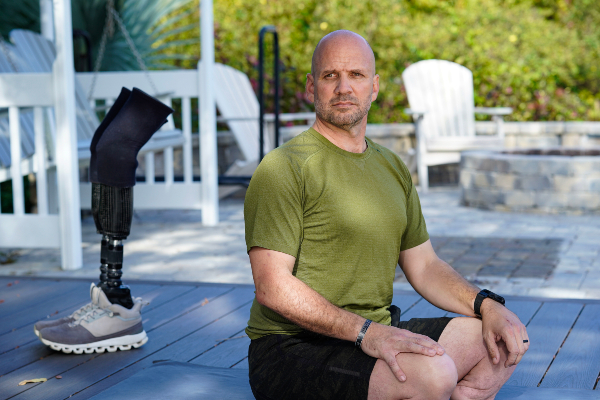
“I would get blown up 10 more times before going through what I did with cancer.”
When Army veteran Dan Nevins says this out loud, people are often shocked by his frankness.
Dan survived combat in Iraq but lost both his legs to an improvised explosive device (IED). As brutal as that was, Dan says he was able to comprehend what happened and what came next.
Then came colon cancer. It hit different, especially after rebuilding life once already.
“Though I wondered how my daughter would look up to me without legs, I knew I would heal,” Dan says. “Cancer was my body not cooperating. There was so much less control.”
Dan’s story is one of blunt honesty. It’s about finding the strength to keep going and peace when you can’t control what’s next.
Wanting to Belong
Growing up as a latch-key kid, Dan didn’t have the kind of built-in support he often saw on television.
“I remember being mad, I didn’t have that connection,” says Dan, recalling a military send-off he watched on TV. The camera zooming in on the families gathered, supporting each other.
The military offered what he craved most. “My country got to be the savior,” he says. “It felt good to serve and be part of something bigger than myself.”
Dan enlisted in the Army in 1991 and served for eight years at posts across Europe and later at Fort Bragg, North Carolina. The uniform gave him structure, identity, and a sense of belonging.
“They were a family unlike anything I knew as a child,” he says.
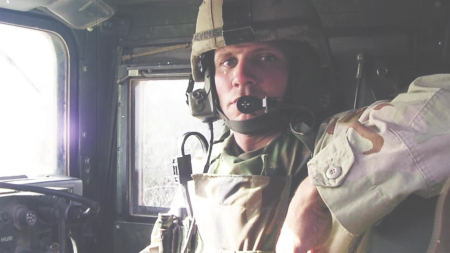
After leaving active duty, Dan moved back to his hometown of Baltimore, then to California, where he found success in finance and pharmaceutical sales.
“I couldn’t quite give up the uniform, though, so I re-enlisted in the Army National Guard,” he shares.
Gazing out on rows of cabernet grapevines from his backyard, “I remember thinking, ‘I made it.’”
Life Interrupted
In late 2003, orders to deploy to Iraq disrupted Dan’s picturesque life.
“I kept thinking, ‘We can’t be doing anything important because our unit isn’t prepared,’” says Dan. “I felt that we were a far cry from the highly trained and equipped personnel I’d last been with at Fort Bragg.”
But the mission was critical.
Over the next 18 months, the unit had one goal: to be the most effective combat unit possible.
“If you didn’t meet your goal, your best friends could die,” Dan says. “So, we were always on.”
Into the Black
Whatever you need – whatever your family needs – we’ll be here for you.
It was 0400 hours on Nov. 10, 2004. Dan was the mission leader.
He took his seat in the lead vehicle, “and into the black we went,” he recalls. “I bent my head in prayer.”
Almost immediately, an IED broke the silence.
“I’m lying in the dirt … my ears are ringing … I taste blood … I couldn’t think clearly … my legs are pinned in … I couldn’t move …”
He didn’t know it at the time, but his femoral artery had been cut. Fire burned around him.
In a moment of clarity, “I thought I’d be MacGyver and fix [it],” he says, laughing.
As he went in and out of consciousness, Dan remembers hearing the unit's medic shout his name, and an Air Force nurse telling him he was lucky. He’d lost his left leg below the knee, and though it was likely he’d lose the other leg, too, he was alive.
A Backpack and a Promise
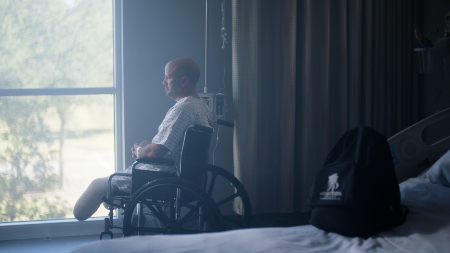
Dan didn’t feel lucky.
At Walter Reed Army Medical Center, doctors tended to his injuries, while he grieved the friends he lost in the explosion and the life he thought he was going back to.
“What can a guy with no legs do?” he asked himself. “How will my daughter look up to me?”
For months, he recalls, “there was nothing but suffering, waiting, and being alone.”
Then one day, a man walked into his hospital room and handed him a backpack.
“He gave me a backpack and a promise,” Dan says. “Whatever you need – whatever your family needs – we’ll be here for you.”
It was his introduction to Wounded Warrior Project® (WWP), and it would reshape the rest of his life.
Finding Connection and Purpose — Again
Through WWP™, Dan began to get comfortable in his new reality as a double amputee. “Disability didn’t define me,” he says.
He was introduced to the world of adaptive sports, learning to snowboard, ski, and even rock climb. But most importantly, he found people who didn’t need an explanation.
“I connected with other wounded veterans who understood what it meant to rebuild a life after injury,” he says. “Wounded Warrior Project became family.”
Living Triumphantly
Dan medically retired in 2006 and moved to Jacksonville, Florida, near WWP’s headquarters. Over the next several years, he stayed in constant motion. He racked up accomplishment after accomplishment.
He climbed Mount Kilimanjaro. He became a single-digit handicap golfer. He rode long distances on an unadapted road bike. He also advocated for veteran issues. In 2008, he was honored by WWP for his advocacy work, receiving the George C. Lang Award for Courage. He also celebrated his oldest daughter when she followed in his footsteps to join the Army.
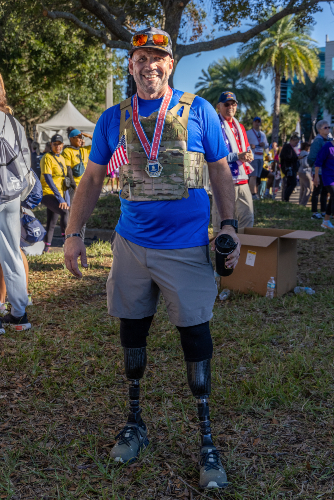
Looking back at that period of his life, Dan admits being active had a purpose.
“I never dealt with the invisible wounds of war. I distracted myself with achievement,” says Dan. “As long as I stayed busy, I didn’t have to.”
When the Diversions Stopped
It’s not uncommon for amputees to need additional surgeries, even years after limb loss. So, Dan didn’t worry when he needed a procedure on his right leg in 2013.
But newly divorced, he found himself recovering alone, without the distractions he’d relied on.
Pain made everything harder. Sleep was elusive. “When I did, I’d have nightmares. So then I’d take a handful of Benadryl and chase it with whiskey and hope I didn’t wake up,” he says.
Dan is quick to add he wasn’t suicidal. “I was spiraling, and I didn’t have a coping tool,” he explains.
Finding the Courage to Ask for Help
“I knew I wasn’t healthy. I needed to talk to somebody.”
Dan joined the WWP staff five years earlier, and although he knew WWP would support him, fear stopped him from reaching out.
“I couldn’t call them. I couldn’t call my team. I didn’t want them to send me somewhere,” he admits.
Instead, he called a friend from a prior job and told her everything — “through tears and snot.”
Her response made him angry.
“She said, ‘Dan, you need some yoga in your life,’” he recalls. “And I was like, ‘That’s the dumbest thing I’ve ever heard.’”
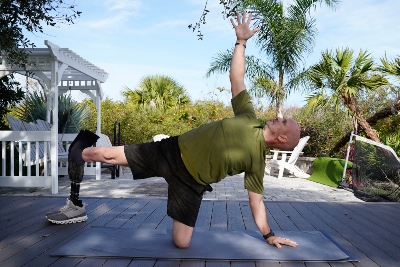
Yoga was a hard no, but they agreed to meet anyway. She convinced Dan to try meditation. For 20 minutes, twice a day, Dan learned to embrace the quiet.
It helped more than he expected.
“The nightmares stopped,” he says. “It cleaned up the mess in my mind a little bit.”
Reluctantly, he gave yoga a shot, too. “I was hot and sweaty and miserable. It hurt, and I hated it,” he recalls. But during the second session, something shifted.
“I just surrendered.”
The experience, he says, was surreal.
“It was a real physical, tangible experience,” he recalls. “Not just the mind-body connection, but like me understanding my place as a human being in the world.”
By the end of his third lesson, Dan signed up for teacher training.
Another Life-Changing Injury
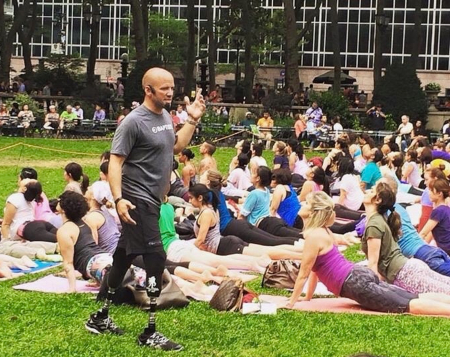
For nearly a decade, Dan focused on healing and sharing the practice of yoga with others — veterans and civilians alike — as a practical tool for well-being.
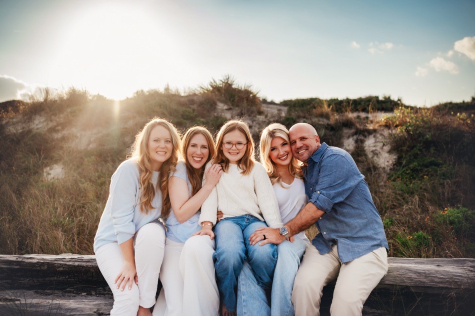
He found love again and started looking forward to his next chapter.
Then, in November 2021, three weeks before his wedding, doctors diagnosed Dan with colon cancer.
The day after his honeymoon, Dan underwent surgery, but complications derailed his recovery. He spent more than a month as an inpatient at Mayo Clinic, his body rebelling.
The Power of the Mind-Body Connection
When doctors ultimately sent Dan home to heal, he couldn’t escape the fact that his body was dying.
“My brain was good, but my body was not cooperating,” he says.
Then one day, he realized he hadn’t prayed or meditated the entire time.
“I was too busy fighting.”
Immediately, he began to pray. Then he meditated for five minutes.
“It was terrible because my brain was all over the place, but I did it,” he says. “When the timer went off, I literally felt my body spark back to life. I knew I was going to live.”
The experience reminded him of what yoga had been teaching him all along. Healing isn’t about being in control; it’s about the connection between mind and body.
“Yoga and meditation didn’t change what happened to me,” Dan says. “They changed how I live now.”
Finding the Gift in Adversity
Dan doesn’t sugarcoat what he’s been through. But he believes hardship can teach you something — if you let it.
“Many people who have had serious trauma and adversity in their lives have a chance to make themselves better in the process,” Dan says.
Cancer brought a similar perspective.
After losing his legs, he questioned what kind of amputee he wanted to be. “There were some people I met in the hospital, and I knew I didn’t want to be like them.”
“I didn’t want it, but it was happening,” he says. “It was an opportunity to ask myself who I am supposed to be now. What can I give up that didn’t serve me before? How do I get better?”
Today, Dan’s health is stable, but his growth mindset remains. He shares it often with other veterans and cancer survivors he meets.
“There’s an African proverb that says, ‘No matter how far you’ve gone down the wrong road, turn back.’ You have the ability to choose something different.”
Healing Doesn’t Happen Alone
Connection remains central to Dan’s life. When he shares his stories with others, his message is the same: Healing does not happen alone.
“Genuine connection matters,” he says. “Being around other warriors, other people like you, is important. It helps you realize the things you’re feeling, and things in your life, they’re all normal.”
For veterans, group experiences through WWP, such as alumni events and physical activities like Soldier Ride, reinforce the values of camaraderie and understanding.
And no matter how long it’s been since service, healing is possible.
Discover Opportunities to Connect with WWP.
Contact: Cynthia Weiss – Public Relations, cweiss@woundedwarriorproject.org, 904.738.2589
About Wounded Warrior Project
Wounded Warrior Project® (WWP) is the nation’s leading veterans service organization, focused on the total well-being of post-9/11 veterans, active-duty service members, and their families. Our programs, advocacy, and awareness efforts help warriors thrive, provide essential lifelines to families and caregivers, and prevent veteran suicides. Learn more about Wounded Warrior Project.

“My life changed in ways I would never imagine,” Dan Smee said during a recent conversation. The Army veteran recounted his experiences as a combat medic in Iraq. “On a daily basis, if you...

“Life has changed quite drastically,” says Army veteran Bill Geiger, reflecting on the 10 years since he decided to get help for his post-traumatic stress disorder (PTSD). “Back then, I was...

Four years after leaving the Navy, Ysabel Cardona learned about Wounded Warrior Project® (WWP). But it would take another decade before the Mexican American mother of two finally found the...